What’s in a Brand Kit, and Why Even a Small Salon Needs One
Your printer, your designer and your staff all make things with your logo. A brand kit makes sure they all look like they came from the same business.
Think about everyone who makes something with your logo on it: the printer who does your visiting cards, the designer who makes your Instagram posts, the shop that paints your signboard, even the staff member who makes a quick WhatsApp poster. Without a guide, each of them guesses. The pink becomes a slightly different pink, the logo gets stretched, and a new font sneaks in.
A brand kit stops the guessing. It is a short set of files and rules that shows exactly how your brand should look.
What a good brand kit includes
- Logo files in every version you need. Full colour, black, white, and a small icon version for profile pictures. In formats for print (PDF, SVG) and for screens (PNG).
- Your colours, with codes. The exact HEX codes for screens and CMYK values for print, so every printer and designer matches them.
- Your fonts. Usually one for headings and one for body text, with notes on where to use each.
- Simple usage rules. How much space to leave around the logo, which backgrounds it works on, and what not to do (stretch it, recolour it, add shadows).
- Ready templates. Social media post and story layouts, a visiting card and a basic letterhead.
- A photo and tone guide. What your photos should feel like, and a few lines on how your brand talks.
A real example: Nails by Manu
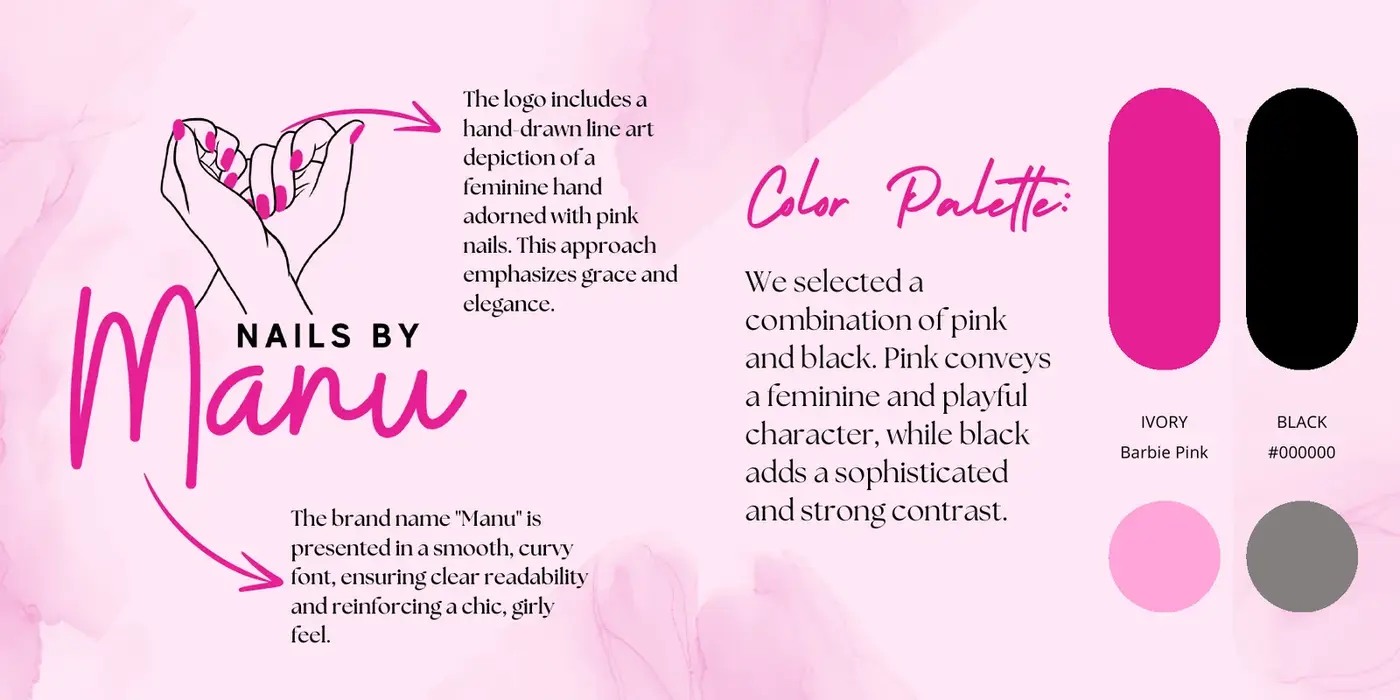
When we built the brand for Nails by Manu, a nail art salon, the logo was a hand-drawn line art hand with pink nails, with the name “Manu” in a smooth, curvy script. The palette was two colours: Barbie pink for a feminine, playful feel and black for a strong, sophisticated contrast.
The brand kit then carried that look into everything the salon uses: social media creatives, the price list for manicures, extensions and removals, business cards and in-salon print. Because the rules were written down once, every piece looks like it belongs to the same salon.
Why small businesses need one most
Big companies have brand teams. A salon, a café or a clinic usually has the owner and whoever is free. That is exactly why a brand kit matters: it lets anyone make something that looks right, without a designer checking every piece.
- It saves time. No more explaining your colours to every new vendor.
- It looks more premium. Consistency is what makes a small business look established.
- It helps people remember you. The same colours and style, seen again and again, become familiar.
How to get one made
- Start with your logo. If it is old or blurry, fix that first.
- Choose two or three colours and two fonts, and stick to them.
- Write the rules in plain language, on one or two pages.
- Create templates for the things you make most often.
- Share the kit with everyone who makes things for you, and keep it in one shared folder.
We design logos and brand kits for businesses across Pune and India. See our branding work or talk to us about yours.
FAQ
What is the difference between a logo and a brand kit?
A logo is one mark. A brand kit is the full set of rules and files around it: colours, fonts, logo versions, templates and usage rules.
Does a small business really need a brand kit?
Yes. Small businesses often have many people making posts and print with no designer checking. A brand kit keeps everything consistent.
What file formats should a brand kit include?
Vector files (SVG, PDF or AI) for print and signage, and PNG files for screens and social media.
Can I make a brand kit for an existing logo?
Yes. We often build a brand kit around a logo a business already has, cleaning it up where needed.
More from the blog.
 Branding
From a Blouse Store to a Fashion Brand: Why Naming Matters
The client wanted a blouse store called Divine Collection. We suggested a bigger idea and a better name. Here is why both mattered.
Read article → Branding
The Power of Visual Storytelling in Brand Building
Attention spans are shorter than ever. Here is how photography, video and a consistent visual identity help a brand stand out and stay remembered.
Read article → Branding
Rebranding a Legacy Business Without Losing Customer Trust
When your business is older than your marketing team, the brand is a trust asset. Here is how we decide what to keep, what to refresh and what to build.
Read article →Your vision.
Our mission.
Tell us about your business. We’ll audit where you stand and send a plan with scope and monthly deliverables.